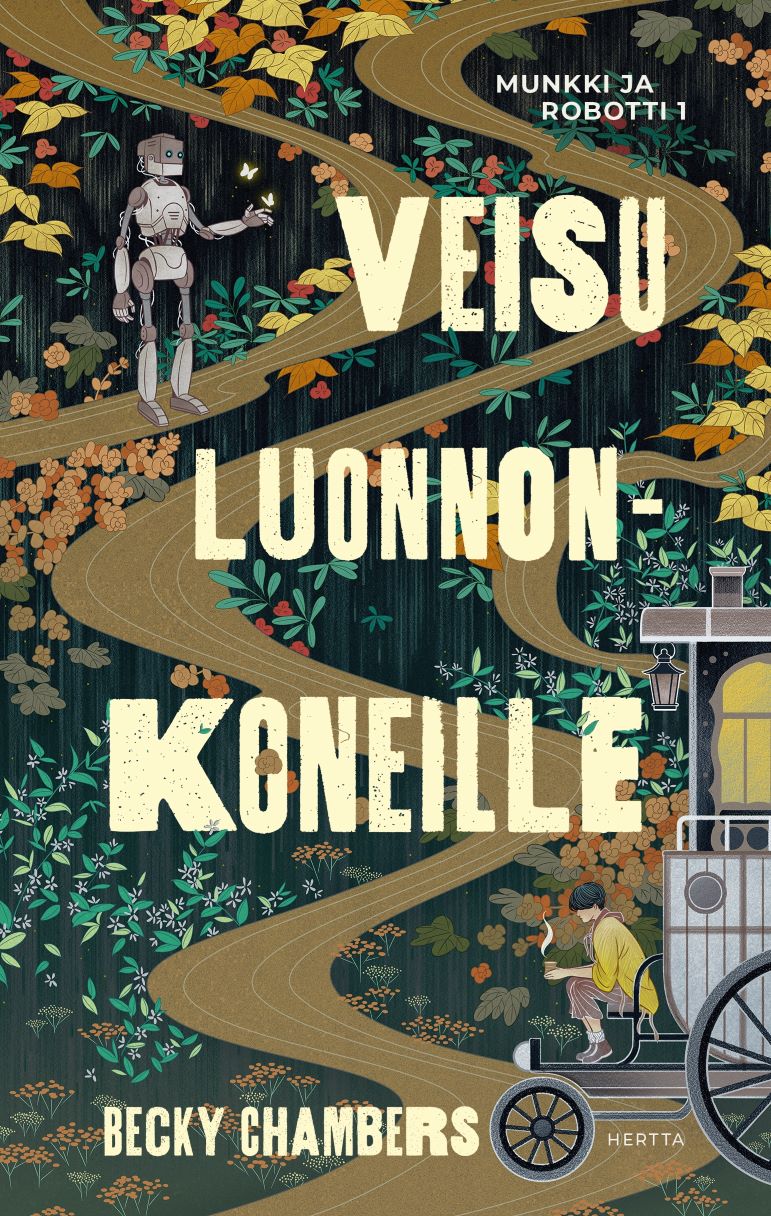
Vuosisatoja sitten Pangan robotit tulivat tietoisiksi ja laskivat tehtailla työkalunsa. Ne vaelsivat yhtenä joukkona villiin luontoon, eikä niitä sittemmin ole nähty. Ihmisten puheissa roboteista on tullut satua.
Sisarus Dex työskentelee kiertävänä teemestarina ja elää sinänsä oikein miellyttävää elämää, mutta häntä kaihertaa tyytymättömyys – ja vetää puoleensa villiintyneen erämaan hiljaisuus ja ihmisettömyys.
Dexin maailma kuitenkin järkkyy, kun luonnon helmassa häntä lähestyy innokkaan tuttavallinen robotti. Ennen kuin robotti voi palata kaltaistensa joukkoon, sen on suoritettava ihmisten parissa tehtävä.
Veisu luonnonkoneille aloittaa Munkki ja robotti -duologian, jonka toiveikas tunnelma on kuin rauhoittavaa teetä lukijan hermoille.
Review of 'A Psalm for the Wild-Built' on 'Goodreads'
4 stars
“You’re an animal, Sibling Dex. You are not separate or other. You’re an animal. And animals have no purpose. Nothing has a purpose. The world simply is. If you want to do things that are meaningful to others, fine! Good! So do I! But if I wanted to crawl into a cave and watch stalagmites with Frostfrog for the remainder of my days, that would also be both fine and good. You keep asking why your work is not enough, and I don’t know how to answer that, because it is enough to exist in the world and marvel at it. You don’t need to justify that, or earn it. You are allowed to just live. That is all most animals do.”
I tend to read whatever the opposite of cozy science fiction is: angry and worried about the world, building tension from speculative extrapolations of what could go …
“You’re an animal, Sibling Dex. You are not separate or other. You’re an animal. And animals have no purpose. Nothing has a purpose. The world simply is. If you want to do things that are meaningful to others, fine! Good! So do I! But if I wanted to crawl into a cave and watch stalagmites with Frostfrog for the remainder of my days, that would also be both fine and good. You keep asking why your work is not enough, and I don’t know how to answer that, because it is enough to exist in the world and marvel at it. You don’t need to justify that, or earn it. You are allowed to just live. That is all most animals do.”
I tend to read whatever the opposite of cozy science fiction is: angry and worried about the world, building tension from speculative extrapolations of what could go wrong. This, on the other hand, is science fiction that encourages you to just chill for a minute.I don’t know if I could read a lot of this, because I am angry and worried about the world, and reading other peoples’ words along the same lines is cathartic. But the message here — that you don’t need to justify yourself, that you can just be — is soothing, and was necessary for me. And it’s all done with wit and care. What a delightful novella.
As other reviewers have already said: it is a truly gentle, hopeful, beautiful story about connection and self discovery and communication. It's got a post capitalist, solarpunk vibe of a world I'd love to inhabit, an appreciation for little pleasures and little deals, loveable characters, and it's also insightful and wise. Plus the main character rides a bicycle as their main form of transportation!
I now want to leave it all and become a wandering tea monk with a bike. That's how perfect this book is. Loved it.
As other reviewers have already said: it is a truly gentle, hopeful, beautiful story about connection and self discovery and communication.
It's got a post capitalist, solarpunk vibe of a world I'd love to inhabit, an appreciation for little pleasures and little deals, loveable characters, and it's also insightful and wise.
Plus the main character rides a bicycle as their main form of transportation!
I now want to leave it all and become a wandering tea monk with a bike.
That's how perfect this book is.
Loved it.
Solarpunk tale of self-discovery and grappling with one's history
5 stars
A compelling yet soothing tale about a non-binary monk having a midlife crisis.
Topics: finding purpose in life, wilderness, the nature of consciousness, and more.
No violence, no struggle apart from that of a person against the pressures of exertion and survival outside of human civilization, and yet it is a page-turner.
It gets the "solarpunk" label because the setting is a human society which fits the bill: non-capitalist, low-impact technology. Main transport method: "ox-bikes," apparently the author's neologism to refer to electronically assisted bicycles that pull carts around. Personal computers are computers that last a person's entire life. Half of the available land is set aside for wilderness. Etc.
100% recommend. It would probably be a good introduction to science fiction for someone who's not familiar with the genre as it exists in the 21st century.
A compelling yet soothing tale about a non-binary monk having a midlife crisis.
Topics: finding purpose in life, wilderness, the nature of consciousness, and more.
No violence, no struggle apart from that of a person against the pressures of exertion and survival outside of human civilization, and yet it is a page-turner.
It gets the "solarpunk" label because the setting is a human society which fits the bill: non-capitalist, low-impact technology. Main transport method: "ox-bikes," apparently the author's neologism to refer to electronically assisted bicycles that pull carts around. Personal computers are computers that last a person's entire life. Half of the available land is set aside for wilderness. Etc.
100% recommend. It would probably be a good introduction to science fiction for someone who's not familiar with the genre as it exists in the 21st century.
The prose is powerful. The attention to detail, opens up our imaginations towards the possibilities of a solarpunk world. High tech only when needed. We're not the center of the cosmos.
This is the kind of science fiction that makes me hopeful. Makes me sad as well. Sad that I will not live to see this world, but it could have been different, if history were to take a different course.
I wish the book was longer. I want to become a tea monk. I want to be a robot that stares at stalagmites for 30 years in a row.
There's a sequel, I know. But I wish there were a thousand sequels.
I can see now why this is a genre defining book, not because it has a solarpunk setting, but because, by existing, it is bringing those ideals and feelings into the real world. This book is a much needed respite for anyone feeling restless, tired or adrift. If you are trying to read something but don't have the effort, this is the book you are looking for
Utopian futures are not usually my thing (dystopia any day), but this was thoughtfully crafted and heart-warmimg so I enjoyed it. The only thing that bothered me a little was the gender pronoun usage. The main character is referred to as "they" throughout, which of course is fine but a little distracting for me.
I read this book in one sitting from start to finish on Christmas day with hot tea and a blanket. It is precisely what I needed for some relaxation and escape. The book is about breaking patterns, dealing with boredom, trying new things, failing and grappling with what it means to be human - all told through the story between sibling dex, a tea monk and a funny robot named mosscap.
It's easy to find dystopian science fiction. It's harder to find science fiction that provides a positive image of the future. It's not a blueprint, but you get the sense of a robust society that has overcome its most self-destructive tendencies. Very on-brand (in a good way!) for the author; if you've enjoyed her other books you will enjoy this one as well.