sol2070@velhaestante.com.br reviewed Palaces of the Crow by Ray Nayler
Moving and beautiful page-turner
5.0 stars
(em português: sol2070.in/2026/05/palaces-of-the-crow-ray-nayler/ )
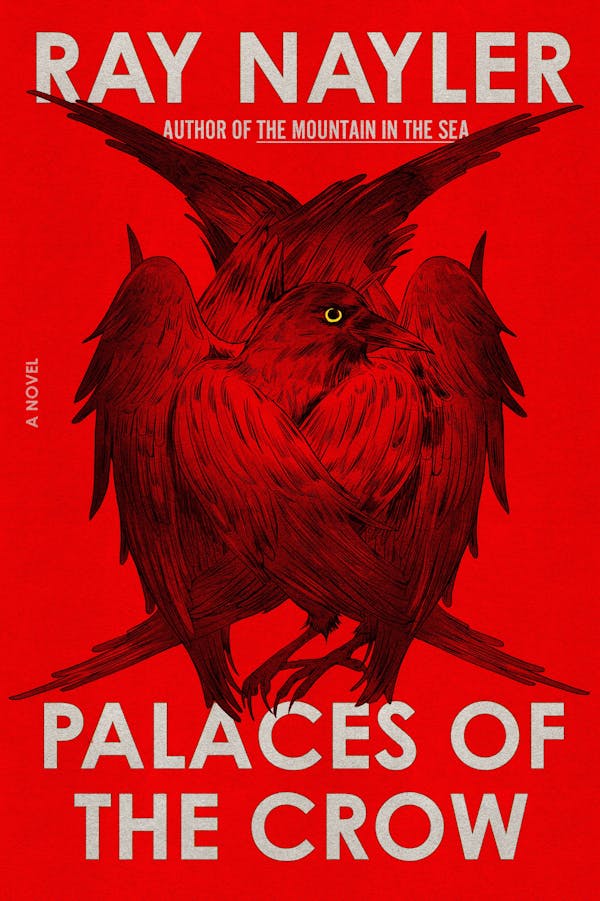
I mark the release dates of Ray Nayler’s novels on my calendar. That was also the case with Palaces of the Crow (2026, 384 pages), the best of his four books, and also the most surprising.
Not only is it an exciting page-turner thriller, but it also manages to be beautiful and poetic within a horrific setting, with emotions so powerful they verge on the transcendental, without resorting to anything supernatural.
I started reading it simply because I’m a fan of the author, since the synopsis itself was only moderately interesting: a group of children and teenagers tries to survive in a forest during World War II, receiving help from crows.
Although it could be classified as science fiction, it is fundamentally a historical novel, with no advanced industrial technology. But it returns to one of Nayler’s favorite themes: animal consciousness, with …
(em português: sol2070.in/2026/05/palaces-of-the-crow-ray-nayler/ )
I mark the release dates of Ray Nayler’s novels on my calendar. That was also the case with Palaces of the Crow (2026, 384 pages), the best of his four books, and also the most surprising.
Not only is it an exciting page-turner thriller, but it also manages to be beautiful and poetic within a horrific setting, with emotions so powerful they verge on the transcendental, without resorting to anything supernatural.
I started reading it simply because I’m a fan of the author, since the synopsis itself was only moderately interesting: a group of children and teenagers tries to survive in a forest during World War II, receiving help from crows.
Although it could be classified as science fiction, it is fundamentally a historical novel, with no advanced industrial technology. But it returns to one of Nayler’s favorite themes: animal consciousness, with evolutionary speculation and nonhuman “technology” that does, in fact, bring it into the realm of science fiction.
I saw this praise online: “Ray Nayler keeps getting better and Palaces of the Crow has already reached another level.” I agree. That is even more impressive because his first novel, The Mountain in the Sea, was already extraordinary.
The new book has been widely praised for its portrayal of nonhuman consciousnesses. Yes, not only is it plausible and captivating — like alien first contact — but it is also emotionally moving and expands the limitations of the dominant mind and culture. But that has been Nayler’s specialty from the beginning; it wasn’t what surprised me most.
What affected me just as deeply was the bond established between the characters, a connection that transcends friendship or family, as the protagonist Neriya — a Jewish preteen in Lithuania before the Soviet annexation — puts it. She eventually joins other orphaned survivors in the forest (a Romani preteen from a decimated village, a little Lithuanian boy) and a Polish teenager who deserts the Red Army.
The war surrounding them turns almost every other human being into an enemy: antisemitic Bolsheviks, hunters, Nazis, militiamen, police, and so on. Neriya had befriended the forest crows while still a child. As a result, they help keep the group alive for years, but their abilities are not limited to friendship.
The World War II setting — amid snow, hunger, and mutual predation — is apocalyptic. It is, after all, a survival novel set at the end of the world, which means that this past is also a projection of the future, or perhaps even of the present.
One of the narrative’s greatest strengths is how it counterbalances total desolation and despair with welcoming, utopian attitudes and emotions. The anarchist classic Mutual Aid, by Kropotkin, appears in the novel’s epigraph, and its basic principle not only guides the plot but also gives its name to the final chapter.
Different nationalities, ethnicities, and even animal species intertwine in mutual aid, not merely to survive, but to flourish.
It had been a long time since I had read a story this moving — my glasses kept fogging up from the steam of tears. And yet it never once slips into sentimentality.
Another masterful aspect is the complete convergence of different plotlines, across different timelines and points of view: the secret of the crows, the fate of the group, what happened in the characters’ adult lives, what came before.
It was one of the most powerful reading experiences I’ve had in years.