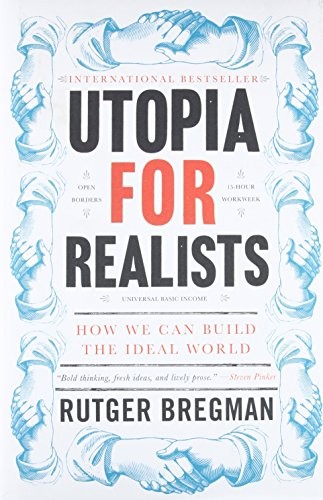

pondweed reviewed Utopia for Realists by Rutger Bregman
Reformation for capitalists
1.0 star
A book written primarily to justify three ideas and defend capitalism. For the subtitle "how we can get there", there is one paragraph in the epilogue to inform the reader that they should unionise, and a fair bit of preaching about how leftists these days just hold ideas without executing them (and not a lot of information on how to execute them, other than to keep talkimg about them).
This author seems to not care about any metric of equity other than economic equality. He upholds IQ as a valid metric (despite it being considered questionable in the '90s), consistently describes cultures as "brutish", ignores anywhere outside North America and Western Europe for 90% of the book, and only brings up social justice when it either reinforces another point or when he wants to disparage it. Native Americans are referred to as "Indians" - though this could be the …
A book written primarily to justify three ideas and defend capitalism. For the subtitle "how we can get there", there is one paragraph in the epilogue to inform the reader that they should unionise, and a fair bit of preaching about how leftists these days just hold ideas without executing them (and not a lot of information on how to execute them, other than to keep talkimg about them).
This author seems to not care about any metric of equity other than economic equality. He upholds IQ as a valid metric (despite it being considered questionable in the '90s), consistently describes cultures as "brutish", ignores anywhere outside North America and Western Europe for 90% of the book, and only brings up social justice when it either reinforces another point or when he wants to disparage it. Native Americans are referred to as "Indians" - though this could be the translator's fault. He also has a very strange idea that there is "nothing to improve upon" in the mind of the average Westerner. He entirely ignores colonialism.
Furthermore, he espouses policies like 15 hour workweeks, UBI, and worker's rights while attempting to work within a capitalist framework. He is a staunch defender of neo-liberals and writes that criticism of them arises from a lack of critical thinking. While he does acknowledge the Overton window and cognitive dissonance, he fails to apply the concepts he warns the audience about to his own ideas.
I will say that this book is well-researched in terms of its key ideas, and makes some interesting points. I especially like his debunking of the idea that poverty arises from moral failings. He draws a comparison to stress from scarcity of time - "you can't take a break from poverty" - in a way that I think makes its point well.
Overall, though, this book is not worth it unless you want to address capitalist problems without dismantling capitalism. I would much rather recommend The End of Capitalism by Ulrika Herrman.