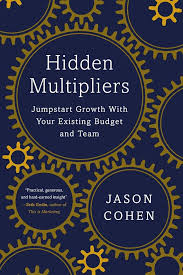
Jason Cohen founded two unicorns. At the first (Smart Bear), its prices went from $35 per seat to $1,300 in four years, yet signups went up. At the second (WP Engine), four changes to pricing and packaging took the company from $1 million to $5 million in a single year.
If you run a business—or a part of one, such as marketing or product—and need to grow it with the money and people you already have, this book explains how to do that using levers like those: what you charge, whom you sell to, how you position it, and why customers leave.
Jason calls these levers "multipliers," and the book explains eleven of them in detail, one per chapter, with a table in the Introduction that guides you from your most urgent problem to the chapter most likely to solve it.
Why haven't you found those levers already? Maybe you don't have the data. Maybe you know exactly what they are, but you're afraid to face them.
A few of the other multipliers:
In one company, with data given in the book, 5% of customers brought in 40% of the profit, while the bottom 10% wiped out 30% of it.
The same product can charge eight times more when its pitch changes from "halves the cost per lead" to "doubles the number of leads."
WP Engine paid affiliates $200 a sale when the going rate was $100, in exchange for exclusivity. By typical financial metrics that was crazy, yet it built a growth channel competitors couldn't access.
With a constant rate of cancellations, growth slows and then stops at a ceiling (2,000 customers in the book's example), however hard you sell.
Each chapter explains why its multiplier works, with examples from many kinds of companies, so you can adapt it to your own. It's written for adults: no worksheets, no templates. AI skills that come with the book walk you through its methods on your own business, step by step.
Over 25 years Jason has built four companies, bootstrapped and venture-funded, and invested in more than 60 startups. He started Smart Bear with no co-founder and bootstrapped it for seven years; WP Engine now has 1,200 employees and serves 200,000 customers.
It's your turn: find your multipliers.