
sol2070@velhaestante.com.br reviewed Goliath's Curse by Luke Kemp
Best book on this topic
5 stars
( em português, com um trecho do livro: sol2070.in/2026/09/goliath-s-curse-luke-kemp#de-anjos-mais-sombrios-ao-suicídio-evolutivo )
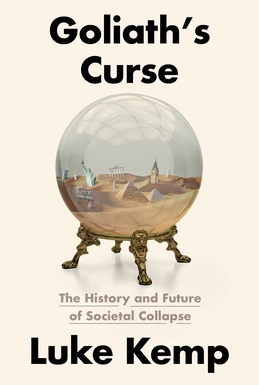
In Goliath's Curse (www.penguinrandomhouse.com/books/691357/goliaths-curse-by-luke-kemp/) (2025, 592 pages), Luke Kemp analyzes the collapse of societies and nations, identifying the patterns of their rise and fall.
It was the best book I've ever read on this favorite topic of nonfiction.
Along the same lines, there's The Dawn of Everything, by David Graeber and David Wengrow. I'm a fan of Graeber, but I skipped through many parts of the book because of the endless digressions (actually, it's unfair to call these tangents digressions. It's Graeber's own style. The fault lay with my expectations and haste). The book is great, but when I read it, I was looking for something more to the point (I still intend to read it from beginning to end).
Goliath's Curse, however, is exactly the book I wanted on this subject.
…( em português, com um trecho do livro: sol2070.in/2026/09/goliath-s-curse-luke-kemp#de-anjos-mais-sombrios-ao-suicídio-evolutivo )
In Goliath's Curse (www.penguinrandomhouse.com/books/691357/goliaths-curse-by-luke-kemp/) (2025, 592 pages), Luke Kemp analyzes the collapse of societies and nations, identifying the patterns of their rise and fall.
It was the best book I've ever read on this favorite topic of nonfiction.
Along the same lines, there's The Dawn of Everything, by David Graeber and David Wengrow. I'm a fan of Graeber, but I skipped through many parts of the book because of the endless digressions (actually, it's unfair to call these tangents digressions. It's Graeber's own style. The fault lay with my expectations and haste). The book is great, but when I read it, I was looking for something more to the point (I still intend to read it from beginning to end).
Goliath's Curse, however, is exactly the book I wanted on this subject.
A researcher at the Centre for the Study of Existential Risk at the University of Cambridge (www.cser.ac.uk/), Kemp deals with the same subject as The Dawn of Everything: how the egalitarian social organization based on hunting and gathering of ancient humans increasingly gave way to hierarchies, domination, exploitation, and states. It's not a linear and binary story as is often propagated.
Kemp calls large-scale societies (states, empires, or civilizations) in which a minority controls, extracts, and plunders resources, dominating through authority and violence, "Goliath." The "curse" of the title is that they self-destruct, lasting on average two or three centuries (with a minimum of a few decades and a maximum of a thousand years). There is a pattern in the causes and conditions of this.
Often, what is commonly called the collapse or decline of a civilization in history and archaeology was actually beneficial to people in general, who began to have better living conditions and expectations—what becomes history is almost always narrated from the point of view of the powerful.
As in Graeber, there is a radical left-wing political lens (well beyond Marxism): social self-organization without leaders, hierarchies, and domination is not a primitive stage possible only in small bands deprived of goods and economic planning. On the contrary, hierarchy and domination are primal, pre-human traits. Several archaeological findings prove the existence of large cities in this egalitarian and decentralized mold, such as in Çatalhöyük 10,000 years ago.
Although the book deals more with the genesis and cataclysm of Goliath structures, there is ample analysis of the egalitarian, or less centralized, societies and models that precede them and to which they return after collapse, in a cyclical movement. And the epilogue is dedicated to "Slaying Goliath."