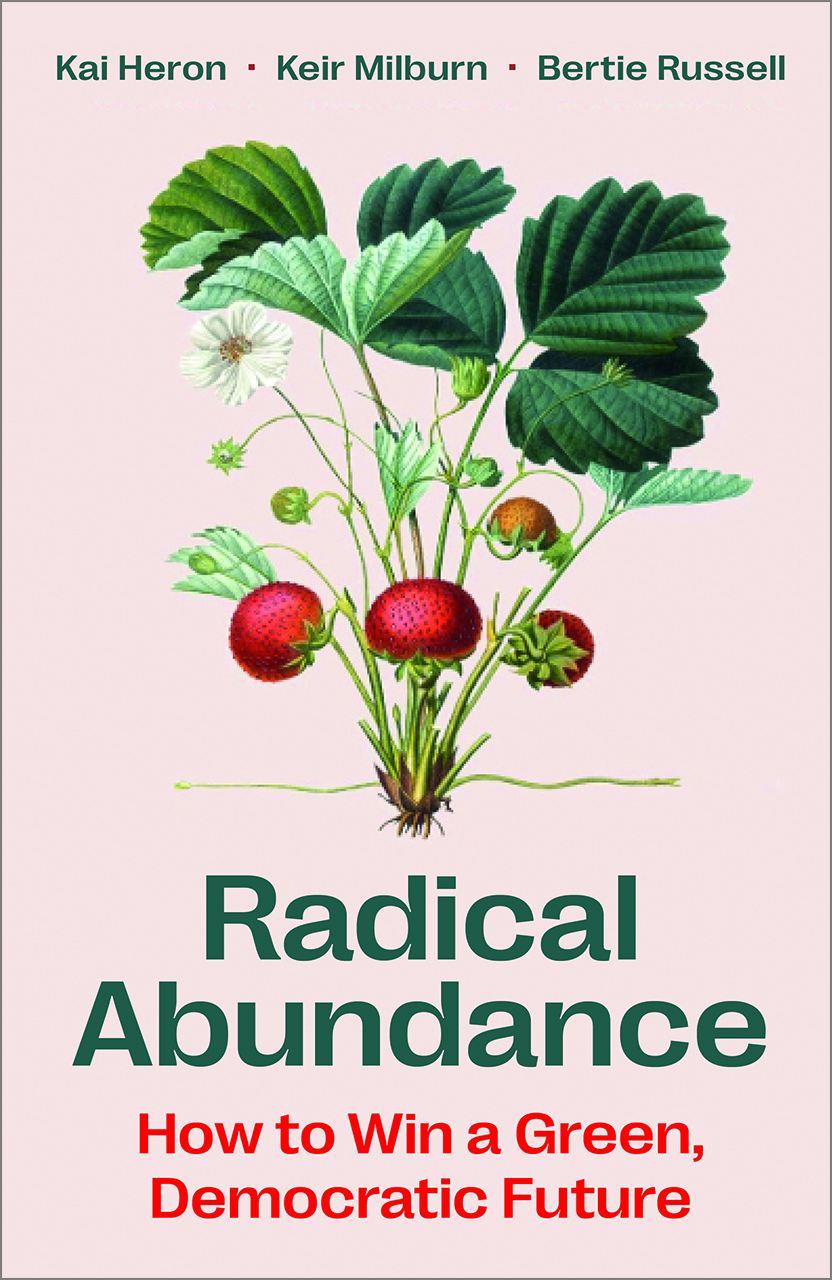

Probel reviewed Radical Abundance by Kai Heron
An inspiring and well-thought opening on how new and co-operative economical institutions are essential in a sustainability transition
5.0 stars
It has been a while since I read something that affected my view of the needed transition as much. I think the book also contains an excellent proposal for institutionalizing sufficiency, which I will come to toward the end.
The authors argue that a transition toward an ecologically and socially sustainable society must express two characteristics:
- popular protagonism - it must enable regular people to take control of their fate and their lives, and to start building a shared sense of a political subject. Otherwise there will be no political project that might have the power to change societal and economic relations.
- contested reproduction - it must contest the capitalist logic of reproducing society, because otherwise capital will continue to rule how resources and work are allocated, and produce an abundance of "bullshit" and an artificial scarcity of things we need. This means creating ways of …
It has been a while since I read something that affected my view of the needed transition as much. I think the book also contains an excellent proposal for institutionalizing sufficiency, which I will come to toward the end.
The authors argue that a transition toward an ecologically and socially sustainable society must express two characteristics:
- popular protagonism - it must enable regular people to take control of their fate and their lives, and to start building a shared sense of a political subject. Otherwise there will be no political project that might have the power to change societal and economic relations.
- contested reproduction - it must contest the capitalist logic of reproducing society, because otherwise capital will continue to rule how resources and work are allocated, and produce an abundance of "bullshit" and an artificial scarcity of things we need. This means creating ways of living and working that are less dependent on capital.
While all this might sound like a description of another utopist ideal, the authors in fact tie this very concretely to action. Based on learnings from initiatives and examples around the world, they propose the idea of Public-Common-Partnerships (PCPs). These institutions incorporate workers, a local community and the public sector into a structure that derisks the contested reproduction and creates spaces to come together and deliberate on matters of production and consumption, that touch the lives of those involved. A PCP could, for example, be the local energy or housing company, and the board would include representatives from the workers, the municipal administration and the people living in the area. The idea is that participating in the PCP is not an ideological decision - it would be in the interest of people in the local community, typically on a municipal level. Derisking could simply mean that the public sector provides favourable terms on eg. property rent or market access, in a manner similar to current derisking of public-private-partnerships. From the get-go, PCPs could potentially start forming a network where surplus is allocated to grow the network and eg. to subsidize PCPs operating in less profitable industries like food production. As examples the authors introduce us to well thought out ongoing initiatives in the field of pharmaceuticals, food production and local community/market spaces.
I think PCPs represent the kind of social innovation that we direly need in order to weave a stronger social fabric that can withstand times of crisis and transition. I find it credible that deliberating and finding compromises with people representing different class interests has the potential to form new kinds of political identities, which otherwise might fall prey to courting from the radical right. The authors rightly point out that PCPs are not the solution: different kinds of institutional forms are needed and any project should be context-aware. But they argue that it is a well-placed gamble, something that could have the potential to radically change lives and livelihoods. It is also something that groups can start organizing right now, and have already started. It is not dependent on first achieving legislative changes or political victories.
Why the slow work of institution building in the time of an accelerating crisis? I think the whole book is based on the premise that an ecological transition is harder than what has generally been assumed, due to the independent momentum of capital flows and how capital can be exchanged to political power. It does not mean that trying to change international and national level policy is useless; but it may not be enough though, and evidence seems to support this. I would argue that institutions that root people to lives less reliant on multinational capital can contribute to tackling multiple growth-dependencies:
some work that is currently purely publicly funded could be moved over to PCPs. So far the answer has been privatization, which has not been the panacea to public budget issues, and some would in fact argue the contrary. PCPs would represent a totally different kind of solution to the growth dependency of the public budget If successful on a larger scale, work and services provided by PCPs could make people less reliant on wages and pensions, reducing pressures to create new jobs (ie. keep the amount of work constant) and to increase pension system yields While there is an idea to grow the PCP network to contest capitalist reproduction, the PCPs do not have strong incentives to grow beyond what is fundamentally useful to filling community needs. A production and decision-making structure based on locality and democracy, would directly counter the consumerist culture and orientation to production and consumption
Due to these characteristics I feel that PCPs have great potential to embody sufficiency.
A major caveat to the model is that, at least in the beginning, it is very reliant on people's ability and desire to organize and participate. The capacity and desire to that might not be as big as we hope. In his seminar at the University of Helsinki, Kai Heron argued that the pioneering examples will mostly be constructed in situations where there is a shared sense of emergency: something is lost to the local community if it cannot find a new way to organize it. I guess this situation might not be very rare in eg. small municipalities in Finland. Heron also gave the example that if you give a famer a choice - guaranteed income and access to community in exchange to give over private ownership of their land - there will be many that say yes.
Finally, a few critical remarks. At some points I felt that the book was lacking nuance in it's capitalism critique. It certainly lacks discussion on the upsides and attractive aspects of traditional enterprises vs PCPs, like streamlined management and clear responsibilities, and how to make PCPs more competitive in these aspects as well. Also, I did not like the redefinition of the term "artificial scarcity" to also cover situations where a capitalist market logic is indeed reinforcing scarcity but resources also are actually scarce. I think it waters down the important term a bit, as in the original use cases of the word, eg. in intellectual or digital property, the resource scarcity is not there.
I highly recommend this book to everyone working with sufficiency and transition. Some parts of it are focused on reiterating the issues in the current capitalist systems of provisioning, and some might even feel overtly ideological. While pointing out the issues is valuable as well, I feel that concrete solution proposals are where the book really shines.