Nice hacking thriller
3.0 stars
( em português: sol2070.in/2025/12/all-that-we-see-or-seem/ )
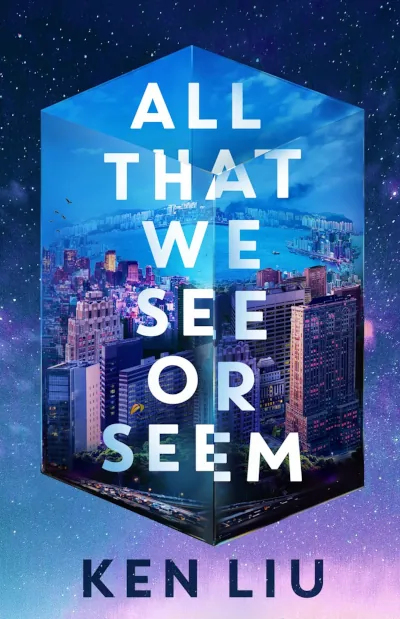
All That We See or Seem (2025, 416 pages), by Ken Liu, is the first novel in the Julia Z series, about a young Chinese American hacker a few decades into the future.
Liu is an acclaimed and bestselling sci-fi and fantasy author in the U.S., also known for the stories that inspired the cult animated series Pantheon[^1].
In the book, a new celebrity in the “vivid dreaming” business disappears under suspicious circumstances. She had ties to a criminal specializing in mass manipulation, someone who manufactures cultural and political phenomena in digital-influence farms staffed with genuinely human—non-bot—interactions. Recovering from traumatic experiences, hacker Julia Z would rather stay out of it, but ends up drawn into the case.
The story reflects heavily on today’s platformized digital mass culture and the worship of influencers, since the central mystery involves the disappearance of …
( em português: sol2070.in/2025/12/all-that-we-see-or-seem/ )
All That We See or Seem (2025, 416 pages), by Ken Liu, is the first novel in the Julia Z series, about a young Chinese American hacker a few decades into the future.
Liu is an acclaimed and bestselling sci-fi and fantasy author in the U.S., also known for the stories that inspired the cult animated series Pantheon[^1].
In the book, a new celebrity in the “vivid dreaming” business disappears under suspicious circumstances. She had ties to a criminal specializing in mass manipulation, someone who manufactures cultural and political phenomena in digital-influence farms staffed with genuinely human—non-bot—interactions. Recovering from traumatic experiences, hacker Julia Z would rather stay out of it, but ends up drawn into the case.
The story reflects heavily on today’s platformized digital mass culture and the worship of influencers, since the central mystery involves the disappearance of Elli, a kind of futurist influencer. The “vivid dreams” she sells are shared visionary experiences at stadium-sized events, where people enter a trance facilitated by neural scanning, augmented reality, and AI. Elli acts like a DJ orchestrating immersive collective visions.
Because these trances are deep, transformative experiences, the cult around these influencers becomes almost a religion — another mirror held up to the present, capturing the cultish quality of online phenomena.
Yet Elli is also an artist. The novel digs into the constant tension between mass commercial production and genuine artistic expression — from the perspective of creators, consumers, and the industry itself.
For instance, her first viral hit is a satire of the white, small-town right-wing conspiracy culture she grew up around. She embodies an unhinged conspiracy theorist obsessed with an absurd belief involving dinosaur DNA. But the performance goes viral not because people grasp the cultural critique — it’s because crowds end up believing the theory.
Of Chinese background himself, Ken Liu also portrays the traumatic experience of migration and racial prejudice, a theme that runs through much of his work.
Although I enjoy his short stories, I don’t share much of his technopolitical outlook — maybe a bit too optimistic about high technology and not too critical of the corporations and political forces fused with it. It’s not that Liu is reactionary; All That… is actually quite progressive in its depiction of corporations, exploitation, and anti-immigrant prejudice. But the way the protagonist relies on her gadgets, especially AI, easily reads as techno-optimism — the bad kind, the kind straight from a tech-billionaire’s ideology deck.
At the same time, that’s also part of the appeal (as with the transhumanism in Pantheon), because Julia uses an ultra-hacked, open-source, do-it-yourself version of an AI — anti-corporate, private, and non-exploitative. Still, the sense of techno-wonder oozing from the pages can get cloying. The science is hard sci-fi, with the characteristic painstaking detail about its tech stuff. It doesn’t get in the way, but it rides the edge.
All That We See or Seem is a page-turning cyberpunk thriller, but paradoxically — given one of its central reflections — it’s the more commercial kind. Not that this is a flaw. Nothing wrong with bestselling, entertainment-driven fiction. Just don’t expect the higher art found in some of Ken Liu’s short stories.